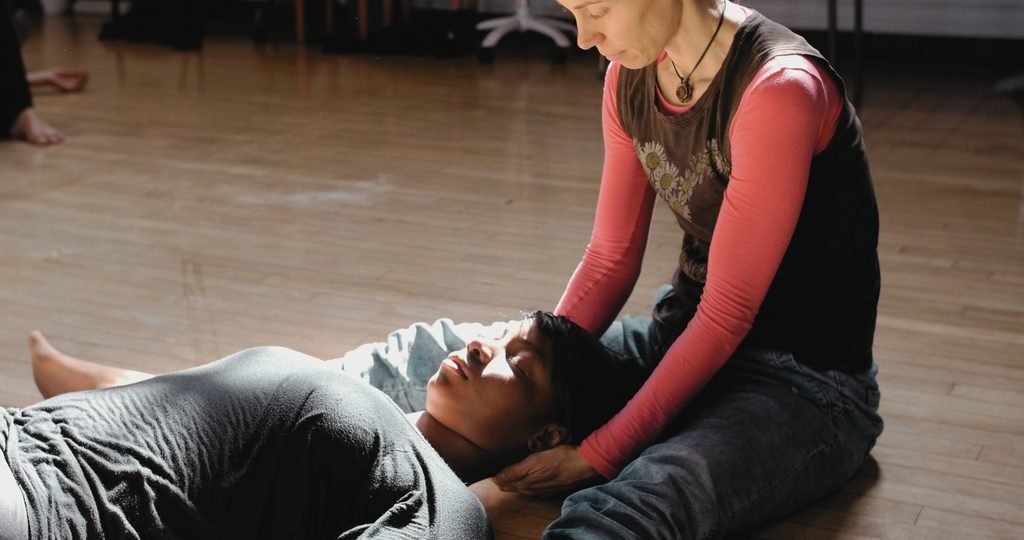
Somatics is the study and practice of the body as it is experienced from within and in relationship. The word comes from the Greek soma or “living body”. Philosopher and movement educator Thomas Hanna named the field in 1976, gathering under one word a family of practices that had been developing for some time.
In the introduction to Sensing, Feeling, and Action, Bonnie Bainbridge Cohen, founder of Body-Mind Centering®, credits Hanna’s
“use of the word ‘soma’ to designate the experienced body in contrast to the objectified body. When the body is experienced from within, the body and mind are not separated but are experienced as a whole. . . . ‘Somatics’ also names a field of study—the study of the body through the personal experiential perspective.”
What’s most common is to approach bodies as objects to measure, manage, train, or repair from the outside. Somatic practice reverses the direction of attention. Sensation becomes the primary source of information. Instead of asking what the body looks like, we ask what it is like to be this body, here, now, moving.
The field includes many systems developed over the past century, among them Alexander Technique, Laban/Bartenieff Movement Analysis, the Feldenkrais Method, Body-Mind Centering®, Ideokinesis, and Continuum. Each has its own principles, vocabulary, and techniques. They share a commitment to first-person experience, attention to sensation and breath, curiosity about habitual patterns, and trust that awareness creates change. To learn more about the different modalities, historical influences, and expressions of somatics, I recommend Dr. Martha Eddy’s book, Mindful Movement: The Evolution of the Somatic Arts and Conscious Action.
The International Somatic Movement Education & Therapy Association (or ISMETA, the professional organization for the field), states that “the purpose of somatic movement education and therapy is to enhance human functioning and body-mind integration through movement awareness.” Practitioners work through postural and movement observation, experiential explorations of anatomy and physiology, movement patterning and repatterning, and guidance offered through touch, words, and demonstration. People learn to sense the moving body more fully, recognize habitual patterns of posture and perception, and discover new possibilities for moving and relating to other people and the environment.
Classes or sessions look less like exercise and more like exploration. A teacher might invite attention, verbally or through touch, to the breath, to the relationship between one’s head and tail, to the weight of their bones, to the quality of their movement or stillness, or to their skin as the boundary between self and world. Change is invited rather than imposed. When a person can feel what they are doing, options appear beyond what any correction can produce. Eventually, they have greater access to this state of sensing which can support them in any context including exercise, sports, housework, and play.